

Data Discovery & Classification

Documents/Day

Data types

High-accuracy models







Across endpoints, servers, and cloud environments, it creates the largest blind spot in modern data security.
Sensitive documents often originate on endpoints and file servers, yet cloud-focused platforms provide little visibility into these surfaces.
Pattern-based detection generates irrelevant alerts
that overwhelm security teams.
Many DSPM tools require 12–24 months to deploy. Kriptos deploys in minutes — no infrastructure changes, no disruption.

Four specialized models. One complete understanding of your data.
Kriptos analyzes every document through four purpose-built AI models
— PII detection, contextual classification, usage scoring, and risk analysis —
working together to deliver accurate, business-aware results.
Document Input
PII Detection
38+ Types
Contextual AI
Business Data
Usage Scoring
Access Patterns
Risk Analysis
Behavior Detection
Complete
Labeled Protected
Compliant
Explore AI Models
AI that understands your data — not just its patterns.
Kriptos applies four specialized AI models to analyze unstructured data and deliver
precise, business-aware classification following AI governance best practices.

Identifies and validates 38+ types of personal data with multi-layer precision.

Custom-trained per customer to understand your terminology, document types, and business context.

Analyzes how users access, store, and modify documents to enable smart, automated policies.

Surfaces early indicators of potential exposure or insider risk before incidents occur.

Complete visibility across endpoints, servers, and cloud.
Kriptos discovers unstructured data across all the places where it is created, stored, and
used — delivering a unified and continuous inventory of your information ecosystem.


Complete visibility into unstructured data on endpoints
— historical, new, and modified files.
Typical workstation:
~5,000 documents
Extreme cases uncovered:
1,000,000+ documents on a single PC

Native discovery across collaboration environments
where unstructured data is actively created and shared.
Typical cloud user:
~2,500 documents
Extreme cases uncovered:
400,000+ documents under one user

Centralized visibility across shared and on-premise file
repositories.
Typical file server:
~1,000,000 documents
Extreme cases uncovered:
15,000,000+ documents on a single server



All findings are consolidated into a single, consistent view — enabling governance, risk analysis, and enforcement, including endpoint detection and response, across every environment where unstructured data lives.

Visual awareness for users. Consistent sensitivity across the organization.
Kriptos applies clear, consistent sensitivity labels that help users understand how data should be handled — without disrupting how they work.
Applies native sensitivity labels for Microsoft Purview and Google Workspace, alongside Kriptos classification labels, ensuring a unified labeling model across environments.
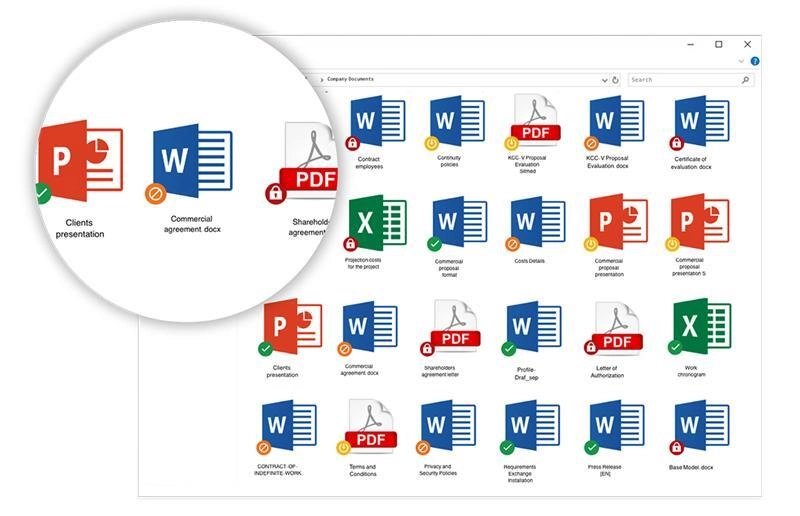
Labels are displayed directly at the point of interaction,
helping users recognize data sensitivity while creating,
accessing, and sharing files.
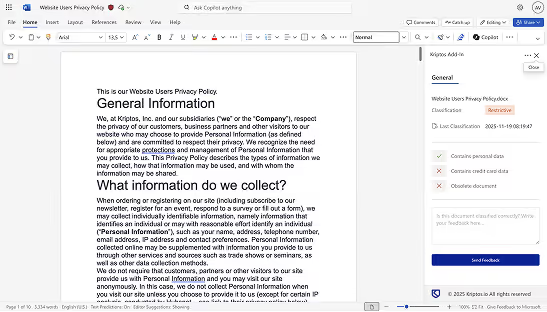
Clear visual indicators make sensitivity immediately
understandable, reinforcing security awareness without
slowing users down.
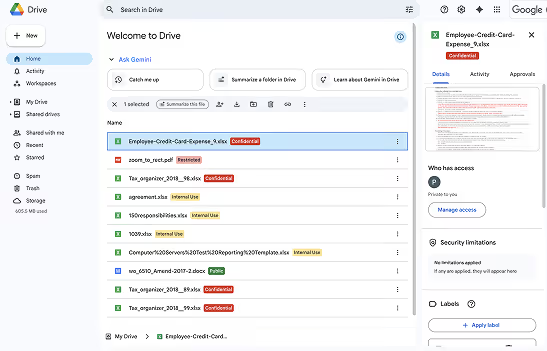
Intelligent labeling reduces human error by making data sensitivity obvious, consistent, and easy to
understand — enabling users to make better decisions every time they interact with information.


Kriptos embeds rich, context-aware metadata directly into file properties—transforming unstructured data
into actionable intelligence for automated enforcement across DLP, CASB, and SIEM platforms.
Every classified document receives embedded metadata properties that travel with the file across endpoints, servers, and cloud environments. This intelligence layer makes unstructured data machine-readable and policy-enforceable without relying on static rules or regular expression–based detection.
Discover Your Data Blind Spots
Kriptos organizes metadata as grouped intelligence,
enabling security tools to make context-aware
decisions and prioritize real threats over noise.

Public, Internal, Confidential, Restricted levels with granular sensitivity indicators.

PCI, HIPAA, GDPR, SOC 2, and other regulatory markers automatically applied based on content analysis.

Content type detection, confidence scores, PII presence, and business-context identifiers.

Anomalous access patterns, sharing behavior signals, and threat intelligence markers.

Metadata embedded in file properties—readable
by all security platforms

This metadata layer powers automated, context-aware enforcement across your existing security stack:

DLP policies trigger automatically based on classification level and compliance markers.
CASB tools enforce sharing restrictions
using risk indicators
and sensitivity context.
SIEM platforms
prioritize alerts by
filtering noise and
surfacing real threats.
IAM systems apply dynamic access controls based on document sensitivity and user beha
AI Models
Time to Value
Accuracy
Endpoint Coverage
Visual Labels

Custom AI
3–5 weeks
Consistently >80%
Generic AI
12–24 months
Typically 40–60%

Limited

See what your current tools are missing.
Full data visibility in weeks, not years.

.svg)